


How to Use Gym Machines Safely and Confidently
A gym can feel very different at 6am before a shift, late at night after work, or during your first ever session. Knowing how to use gym machines takes away much of that uncertainty. Once you understand a few simple adjustments and movement cues, the equipment becomes a practical way to train safely, build strength and stay consistent.
Machines are not only for beginners, and free weights are not automatically better. Both have a place. A machine guides the movement along a fixed path, which can help you focus on the muscle you want to train rather than balancing the weight. That makes them especially useful when you are learning, returning after time away, training alone or fitting a focused workout into a busy day.
Start with the set-up, not the weight
The first weight you choose matters less than how the machine fits your body. A poorly adjusted seat can turn a useful exercise into an awkward one, even with a light load. Before every new machine, take a moment to find the adjustment levers, pins and handles.
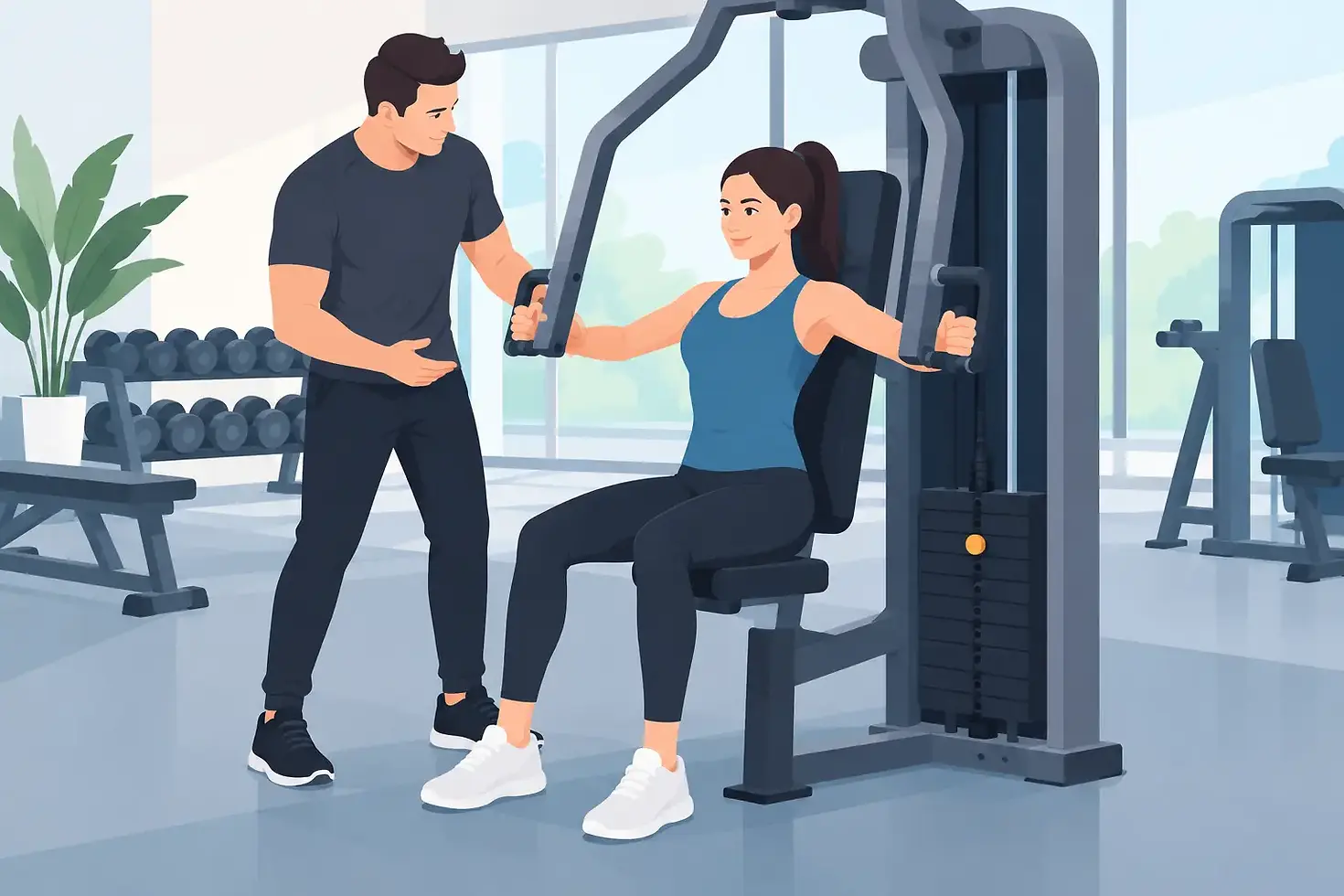
Set the seat so the joint you are moving lines up roughly with the machine's pivot point. On a leg extension, for example, your knee should be in line with the point where the machine arm rotates. On a chest press, the handles should sit around mid-chest level rather than up by your shoulders or down near your ribs.
Adjust pads so they hold you in place without digging in. If a machine has a thigh pad, such as a lat pulldown, secure it over your legs firmly enough that you do not lift from the seat when pulling. Keep your feet flat where footplates are provided and choose a backrest position that lets you sit tall without over-arching your lower back.
A good rule is that the movement should feel controlled from the very first repetition. If you are stretching, reaching or twisting to get into position, stop and adjust it.
How to use gym machines with good form
Your aim is not to move the heaviest stack possible. It is to move a suitable weight through a comfortable range with steady control. Start lighter than you think you need. You can always increase the pin by one plate on your next set, while starting too heavy often leads to rushed reps and poor positioning.
Use a calm tempo. Lift or press the weight smoothly, pause briefly when you reach the end of the movement, then return slowly. Avoid letting the stack crash down between repetitions. That return phase is part of the exercise and is where you build control.
Keep your breathing simple: breathe out during the effort, such as pressing the handles away or pulling the bar down, and breathe in as you return. You do not need to hold your breath to make a machine effective.
Most people will benefit from eight to 15 controlled repetitions for one to three sets when starting out. The final few repetitions should feel challenging, but you should still be able to keep your posture and avoid jerking the weight. If you could easily continue for many more reps, increase the weight slightly next time. If your form changes before you reach your target reps, reduce it.
Get familiar with the main types of machine
Leg press and leg extension
The leg press trains your quads, glutes and hamstrings. Sit with your back against the pad and place your feet about hip to shoulder width on the platform. Lower the weight until your knees are comfortably bent, then press through your whole foot to return. Do not lock your knees sharply at the top, and do not let your lower back curl away from the pad as you lower.
On the leg extension, line your knees up with the machine pivot and position the roller pad just above your ankles. Lift your lower legs until they are nearly straight, then lower with control. This exercise is best performed steadily rather than with a heavy, swinging load.
Chest press and shoulder press
For a chest press, adjust the seat until the handles are level with the middle of your chest. Keep your shoulder blades gently back against the pad and press forwards without allowing your shoulders to creep towards your ears. Return until you feel a comfortable stretch across your chest, not a pinch at the front of the shoulder.
On a shoulder press, the handles should begin around ear or shoulder height. Keep your ribs down and your back supported. If you need to arch dramatically to press the weight overhead, it is too heavy or the seat needs adjusting.
Lat pulldown and seated row
The lat pulldown works your upper back and arms. Sit tall, secure your thighs beneath the pads and take a grip that feels comfortable. Pull the bar towards the top of your chest while bringing your elbows down and back. Do not pull the bar behind your neck, and avoid leaning far backwards to force the weight down.
For a seated row, sit close enough that you can reach the handles without rounding excessively. Pull towards your lower ribs or waist, keeping your chest proud and shoulders away from your ears. Think about driving your elbows back rather than simply pulling with your hands.
Cable and selectorised machines
Cable stations give you more freedom of movement, but they need the same care with set-up. Check that the attachment is clipped on securely, choose the correct height for the exercise and stand in a stable position before lifting the pin weight. Keep the cable under control when finishing a set rather than letting the handle snap back.
Selectorised machines are the ones with a weight stack and pin. Always make sure the pin is pushed fully through the chosen plate. Change the weight only when the stack is fully resting, and never place fingers near the moving plates.
Use the machine's instructions, but listen to your body
Most machines have a diagram showing the intended movement and the muscles being trained. Use it as a starting point, particularly if the equipment is new to you. The image cannot account for every body shape, mobility level or old injury, though, so comfort matters too.
A normal training sensation is muscle effort, warmth and fatigue. Sharp pain, tingling, numbness or pain inside a joint is different. Stop the exercise if that happens. Try adjusting the seat or range of movement, or choose another option. There is no prize for forcing an exercise that does not suit you.
This is also why copying someone else's seat setting or weight is rarely helpful. Two people can use the same machine very differently because of their height, limb length, experience and goals.
A simple machine workout for a first session
If you are unsure where to begin, choose one machine for each main area: leg press, chest press, lat pulldown, seated row and a core or leg exercise that feels comfortable. Complete one light practice set on each machine first. Then do two working sets of eight to 12 repetitions, resting for around 60 to 90 seconds between sets.
This is enough for a productive first workout. You do not need to use every station, train until exhausted or spend two hours in the gym. Consistency will do more for your results than one punishing session followed by a week away.
As confidence grows, you can add exercises, increase a weight gradually or include free weights and functional training. It depends on your goal. Someone building general fitness may keep sessions simple and full-body, while someone training for strength or physique goals may use machines to add targeted work after bigger lifts.
Ask for support early
Even experienced gym-goers ask questions when using an unfamiliar machine. A quick check can save weeks of practising the wrong movement. At Failsworth Fitness 24/7, members can train around their own schedule while still having access to a friendly team, personal training and guidance built around individual goals.
Take your first few sessions slowly. Learn the set-up, keep the weight manageable and leave feeling like you could return tomorrow. That confidence is what turns gym machines from intimidating equipment into reliable tools for helping you look, feel and perform at your very best.


Comments